Real-Time Warehouse Order Management PWA
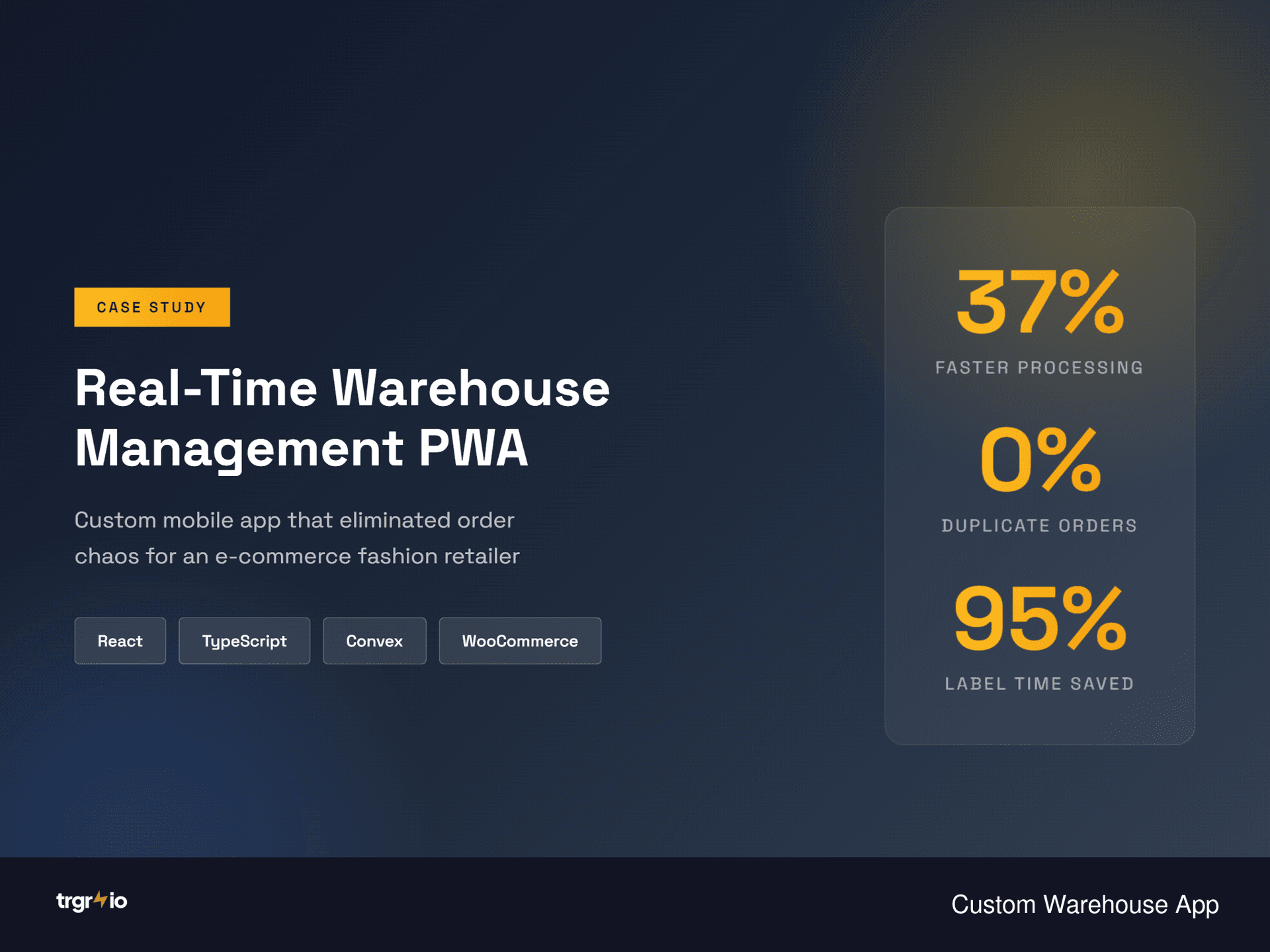
Replaced paper-based warehouse operations with real-time PWA, achieving 37% faster order processing.
The Challenge
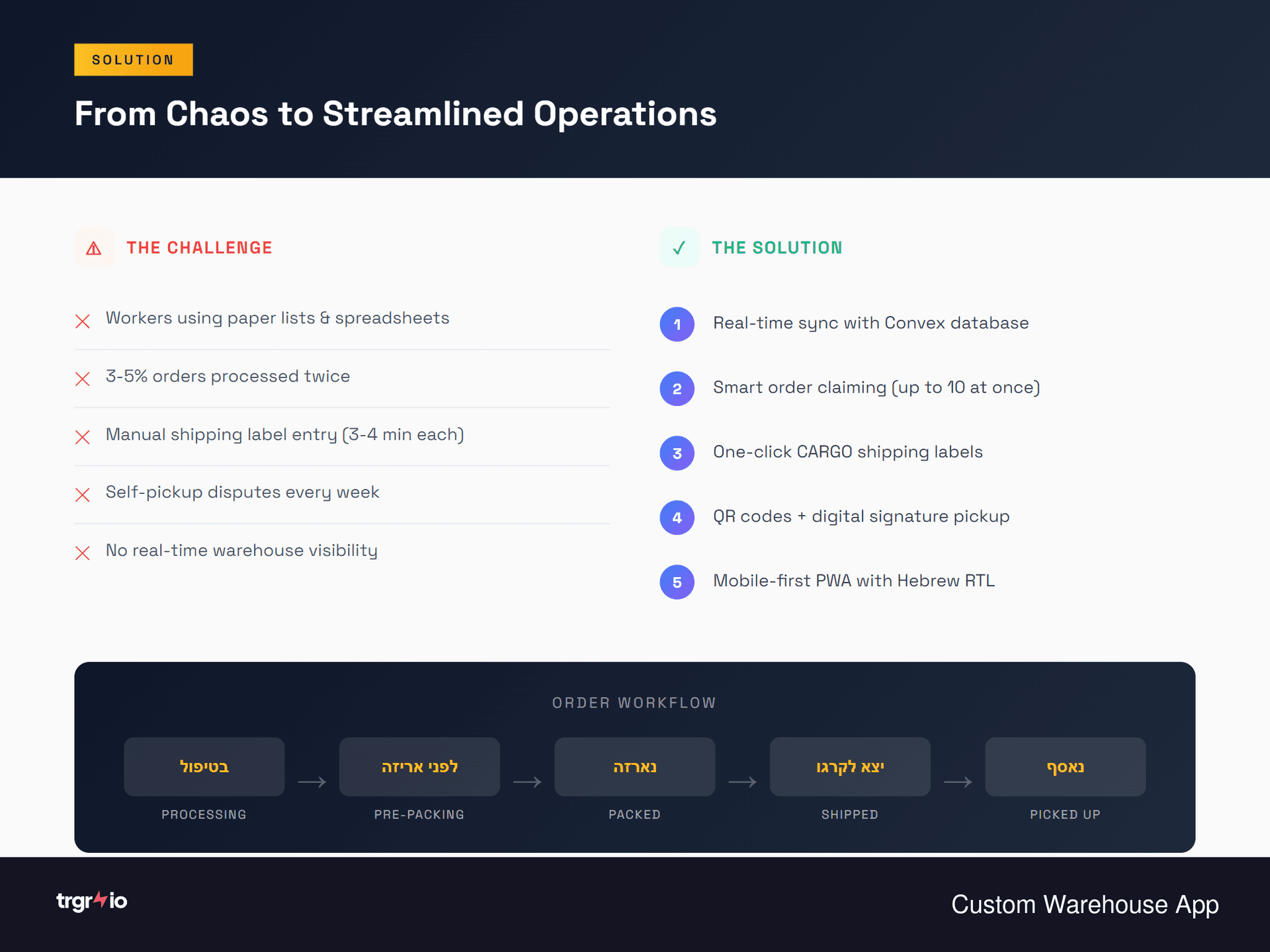
A fashion e-commerce retailer processing 150-200 orders daily from their WooCommerce store ran their warehouse on printed paper pick lists and a shared Google Sheet for status tracking. The problems were systemic: 3-5% of orders were processed twice because two warehouse workers would grab the same order from the queue without knowing, there was zero real-time visibility into what was packed and what was pending (the Sheet was updated at end-of-shift), and 15-20 minutes per shift were wasted on verbal coordination between 4 warehouse staff. Self-pickup customers had no verification system — they'd show up and staff had to dig through paper records to find their order. During peak sale periods (Black Friday, end-of-season), the chaos multiplied and error rates spiked to 8-10%.
Our Solution
We built a Progressive Web App (PWA) that runs on the warehouse team's existing Android phones and a shared tablet at the packing station. The app connects to WooCommerce via real-time API polling and presents orders in a priority queue with smart assignment: when a worker claims an order, it's instantly locked and removed from everyone else's queue, eliminating duplicate processing. Each order shows item photos, sizes, colors, and bin locations for efficient picking. Workers update status with one tap (picked → packed → shipped), and every status change syncs in real-time to all devices via Convex's reactive database. Shipping label generation is integrated — workers scan a barcode or tap a button to generate labels from the configured carrier API. For self-pickup orders, we built a digital signature capture screen where customers sign on the tablet, and the signature is stored as an image linked to the order record in WooCommerce.
Detailed Approach
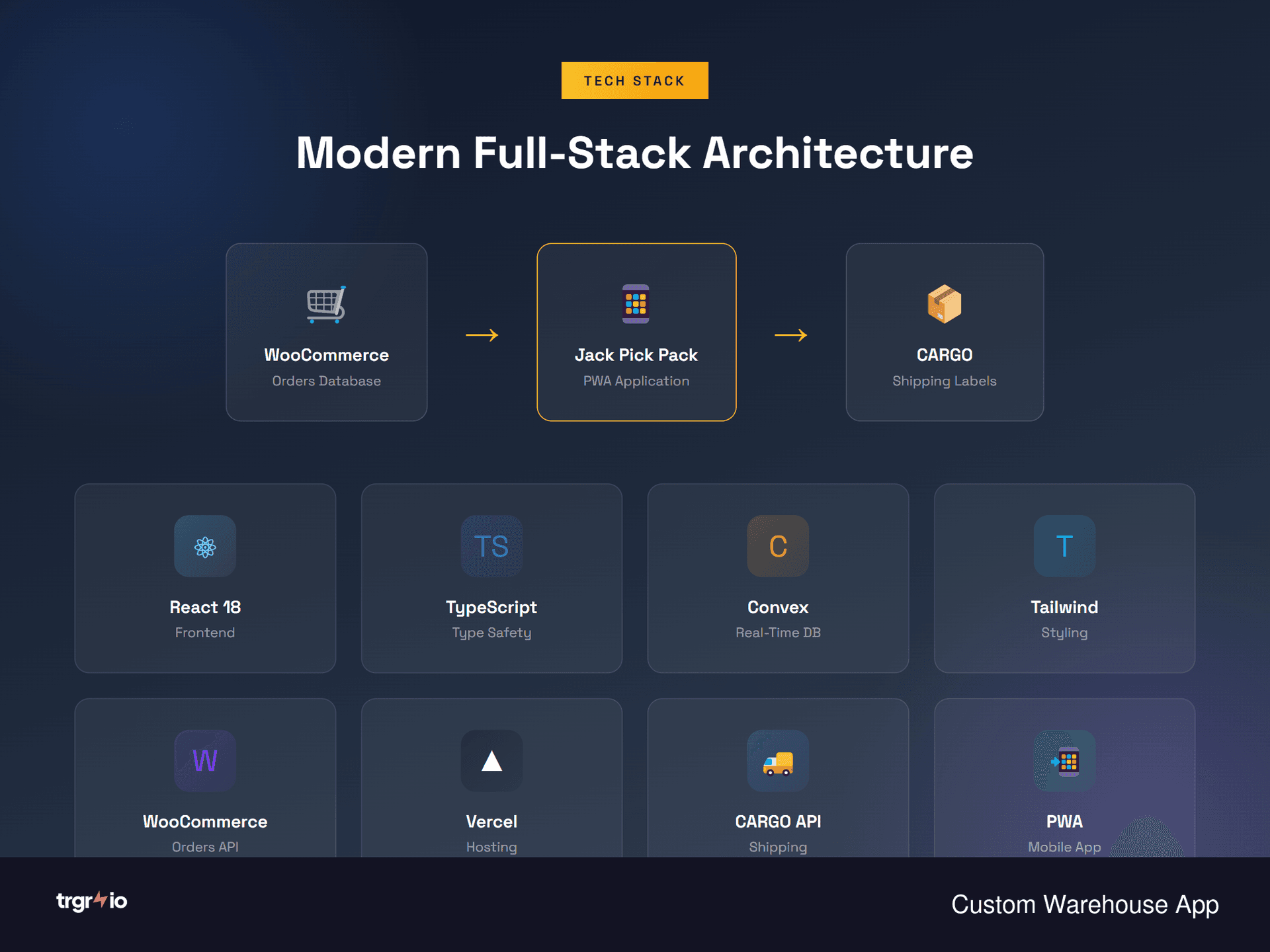
We chose to build a PWA rather than a native app for three reasons: instant deployment without app store approval, works on any device with a browser, and the warehouse team could start using it immediately by adding it to their home screen. The tech stack — React, TypeScript, and Tailwind CSS on the frontend, Convex for the real-time backend — was chosen for development speed and excellent real-time sync capabilities.
Convex was the key architectural decision. Unlike traditional REST APIs where you poll for updates, Convex provides reactive queries that automatically push changes to all connected clients. When Worker A claims an order, Workers B, C, and D see it disappear from their queue within 200ms — no refresh needed. This instant sync is what eliminated the duplicate processing problem entirely. The order locking mechanism uses Convex mutations with optimistic concurrency control: if two workers try to claim the same order simultaneously, only the first succeeds and the second gets a graceful "already claimed" notification.
The WooCommerce integration polls the REST API every 60 seconds for new orders and status changes, syncing them into Convex. We built a bi-directional sync: status updates in the PWA write back to WooCommerce, updating the order status and adding tracking numbers so customers get automatic shipping notifications. The shipping label integration connects to the carrier's API (Israeli Post and courier services), generating labels as PDFs that can be printed directly from the packing station tablet.
Key Results
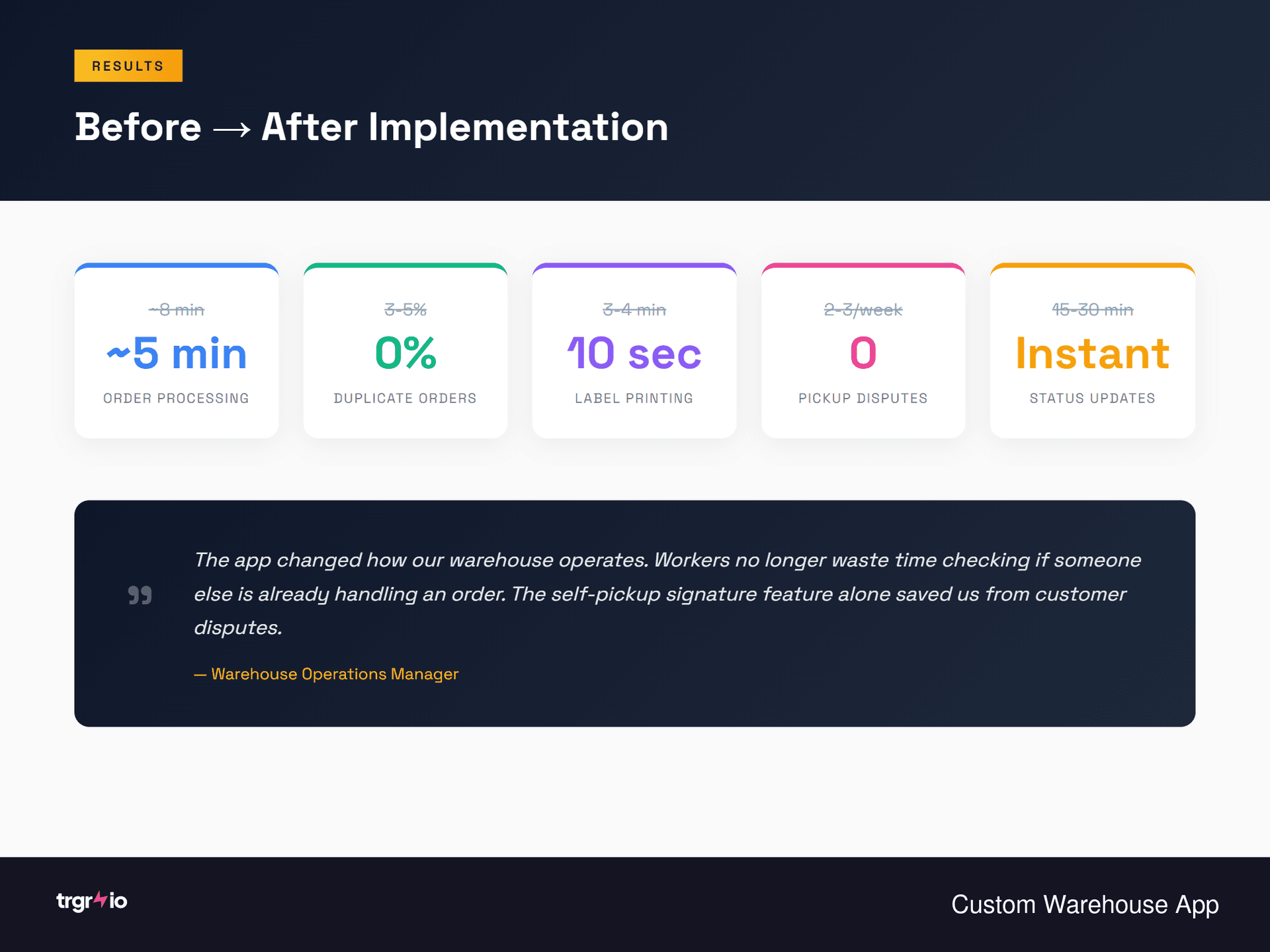
🕐 UX design and WooCommerce API mapping took 1 week- ✓37% faster average order processing — from 8.2 minutes to 5.2 minutes per order
- ✓Duplicate order processing eliminated completely — from 3-5% to 0%
- ✓Real-time dashboard gives management instant visibility into warehouse throughput
- ✓Self-pickup verification time reduced from 5-10 minutes to 30 seconds with digital signatures
- ✓Zero paper usage in warehouse operations — fully digital workflow
- ✓Peak period (Black Friday) error rate dropped from 8-10% to under 1%
UX design and WooCommerce API mapping took 1 week. Core PWA development with Convex real-time backend took 3 weeks. Shipping integration and signature capture added another week. The team piloted the app alongside paper processes for 5 days before full cutover.
Technology Stack
Learn More
Dive deeper into the strategies and frameworks behind this project:
Related Services & Industry
Next
Send the week you keep repeating.
Ops Assessment. If this pattern is yours, we will say so.
Pull the trgrAssessment · $999